8K UHD Mode: When to Use Ultra-Resolution vs 4K Native
Ever thought if your eyes can see the difference between standard HD and the latest ultra-resolution formats? As display tech gets better, the difference between 4K and 8k uhd ai porn grows bigger.
It’s key to know these tech details if you want to get the most out of your home theater. You might wonder if your gear can handle the big data needs of these high-quality streams. Choosing the right resolution depends on how far you sit and the quality of what you’re watching.
This guide dives into the practical side of modern display standards. We aim to help you understand the digital media world better. By the end, you’ll know when to go for more pixels or stick with standard playback.
Key Takeaways
- Learn the fundamental differences between 4K native and ultra-resolution formats.
- Discover how viewing distance impacts your perception of image clarity.
- Evaluate if your current hardware supports high-bandwidth video playback.
- Understand the role of software processing in enhancing visual fidelity.
- Make informed decisions to achieve the best possible home viewing experience.
Understanding the Technical Differences Between 4K and 8K
The leap from 4K to 8K in high-resolution media is huge. It shows how much more detailed and clear our screens can be. Whether watching movies or 8k ai porn, the number of pixels affects how sharp the image is.
Defining Native 4K Resolution
Native 4K, or Ultra HD, has 3840 x 2160 pixels. This means it has about 8.3 million pixels, four times more than Full HD. This high number makes images look sharp and detailed, even on big screens.
The Mechanics of 8K Ultra-Resolution
8K UHD is a big step up, with 7680 x 4320 pixels. It has about 33.2 million pixels, four times more than 4K and sixteen times more than Full HD. This density makes images incredibly lifelike, showing textures and details that were hard to see before.
“The true power of ultra-high resolution lies not just in the pixel count, but in the ability to create a sense of presence that makes the digital world feel tangible.”
How AI Upscaling Bridges the Gap
AI upscaling is key when 8K content is rare. It uses smart algorithms to make lower-resolution videos look like native 8K. This tech is great for 8k ai porn, where keeping skin texture and details sharp is crucial for a good view.
| Resolution Standard | Pixel Dimensions | Total Pixel Count |
|---|---|---|
| Full HD (1080p) | 1920 x 1080 | 2.1 Million |
| 4K UHD | 3840 x 2160 | 8.3 Million |
| 8K UHD | 7680 x 4320 | 33.2 Million |
Thanks to AI upscaling, you can get a top-notch view even with non-native 8K content. This tech makes sure your high-end display is always worth it, no matter the source. Knowing these differences will help you get the best out of your 8k ai porn collection.
Evaluating Your Hardware Requirements for High-Resolution Playback
Smooth playback of high-resolution content relies on your hardware. Your system must handle large data without lag. Setting up your ultra hd settings correctly is key for a great viewing experience.
Display Capabilities and Pixel Density
Your monitor is crucial for visual quality. A low pixel density display can’t show detailed content well. Screen size is important for high-resolution viewing.
Small monitors might not show the difference between standard and ultra-resolution. But, larger screens can display more details clearly. Make sure your display supports the resolution you want.
GPU and Processor Demands for Smooth Playback
High-resolution video needs strong graphical power. A good Graphics Processing Unit (GPU) is vital for smooth playback. Your processor also needs to handle the data load.
Without a dedicated GPU, your system might struggle with modern video files. This can cause stuttering or audio-visual issues. A modern graphics card helps your hardware keep up with demanding content.
Bandwidth and Storage Considerations
Streaming high-resolution content requires fast internet. You need 50–100 Mbps or higher speeds to avoid buffering. If your connection is slow, your ultra hd settings might lower automatically.
Storage is also key if you download media. High-resolution files take up a lot of space. A fast Solid State Drive (SSD) ensures quick access and smooth playback.
Optimizing Your Setup for 8k uhd ai porn Content
Setting up your workstation for high-end video playback is crucial. It ensures every pixel is sharp. When dealing with 8k uhd ai porn, your system must handle big data smoothly. The right software and hardware are key for a great viewing experience.
Selecting the Right AI Upscaling Software
Choosing the right software is essential for your library. Tools like Topaz Video AI are top choices for upscaling. They use AI to bring back lost details in compressed videos.
- Look for software that supports hardware acceleration via your GPU.
- Prioritize tools that offer batch processing for large libraries.
- Ensure the software supports modern codecs like HEVC or AV1.
Configuring Graphics Settings for Maximum Fidelity
Your graphics card is crucial for display performance. Adjusting NVIDIA or AMD settings can improve texture clarity. Enabling high-performance modes and anisotropic filtering are key steps.
Set your display’s refresh rate to its maximum. This prevents screen tearing and keeps motion smooth. Consistency in frame rate is as important as resolution.
Managing File Sizes and Compression Artifacts
High-resolution files are big, which can cause storage issues. Use efficient codecs to keep quality while managing size. Hardware-accelerated decoding helps your graphics card handle the load.
Blocky artifacts in 8k uhd ai porn? Try increasing the bitrate during processing. This might make files bigger, but it improves quality. Finding the right balance is essential for a top-notch viewing experience.
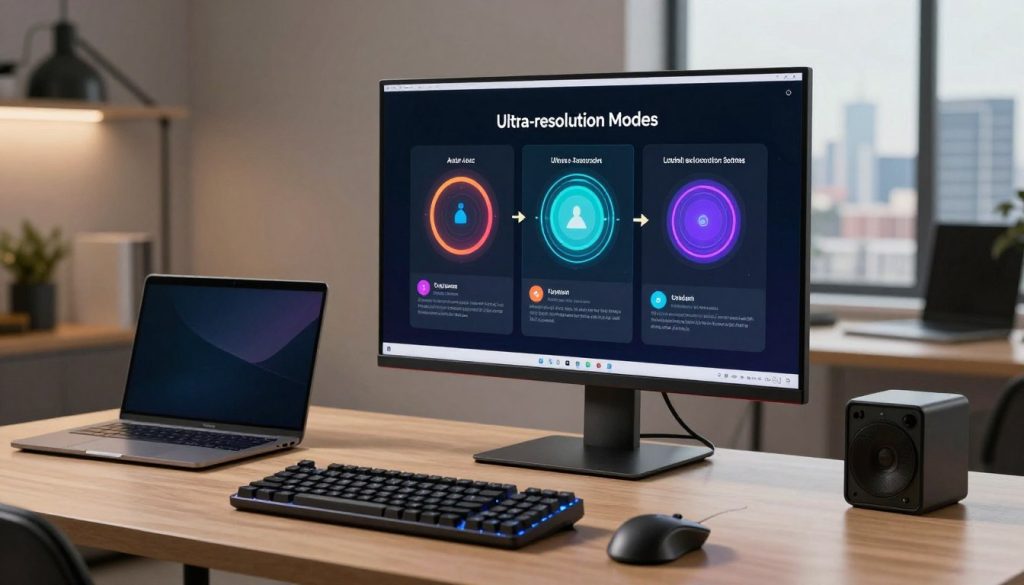
Step-by-Step Guide to Enabling Ultra-Resolution Modes
To get the most out of your display, you need to make some adjustments. High-end hardware is just the start. Correct software configuration is key to clear images. Follow these steps to enhance your visual experience.
Accessing Display Settings on Windows and macOS
On Windows, go to the “Display” menu in System Settings. Make sure your resolution is at the native maximum your monitor supports. Also, check that the “Display Adapter Properties” show the right refresh rate.
For macOS, open “System Settings” and click on “Displays”. Press the “Option” key while clicking “Scaled” to see all resolutions. Always confirm your cable can handle ultra-resolution signals.
Adjusting Media Player Preferences for High-Bitrate Files
High-bitrate files need strong processing to avoid stuttering. In your media player, like VLC or MPC-HC, go to “Input/Codecs” or “Hardware Acceleration”. Enable hardware-accelerated decoding to let your GPU do the work.
Also, check the “Output” settings for the best renderer. Using “Direct3D 11” or “Metal” can improve playback. Fine-tuning these preferences keeps your system stable, even with complex scenes.
Calibrating Color Profiles for Enhanced Visuals
Getting the right colors is as important as high resolution. Use your OS’s color management tool to apply a profile that fits your monitor. This prevents washed-out colors and ensures deep blacks and vibrant highlights are correct.
If you’re serious about color, use a hardware colorimeter for precise calibration. It measures your screen’s light output and creates a custom profile. The table below shows recommended settings for different displays to get the best visuals.
| Setting Category | Windows Recommendation | macOS Recommendation | Performance Impact |
|---|---|---|---|
| Resolution | Native Maximum | Scaled (Option Key) | High |
| Color Depth | 10-bit or Higher | Deep Color Mode | Medium |
| Hardware Acceleration | Enabled (DXVA) | Enabled (Metal) | Critical |
| Refresh Rate | 60Hz or 120Hz | ProMotion/Max Hz | Medium |
Comparing Visual Fidelity: When Native 4K Outperforms 8K
Many people think that higher resolution means a better picture. But this isn’t always true. Native 4K content often gives a clearer picture than 8K, especially if 8K is just upscaled.
The Role of Source Material Quality
The quality of your image depends a lot on the source material. Trying to upscale low-quality footage to 8K just makes the problems worse. Upscaling algorithms can’t always tell real details from digital noise, leading to weird textures.
“The most important factor in image fidelity is not the display resolution, but the integrity of the original source file.”
Identifying Motion Blur and Processing Latency
Trying to display 8K requires a lot of computer power. This can cause processing latency, making things feel slow. Also, if your computer can’t handle it, you might see more motion blur in fast scenes.
On the other hand, native 4K is easier on your computer. It doesn’t need to upscale in real-time. This means your computer can keep up with the action, making everything look smoother.
Why Native 4K Often Provides Better Stability
Our eyes can only see so much detail, especially at a distance. To see all the detail in a 4K image on a big TV, you need to be very close. Beyond that, the extra pixels in 8K don’t make a big difference.
Choosing native 4K means you get a stable, high-quality image. It avoids the problems that come with over-processing. Here’s a table that shows the main differences between native 4K and upscaled 8K.
| Feature | Native 4K | Upscaled 8K |
|---|---|---|
| Processing Load | Low/Moderate | Very High |
| Visual Stability | Excellent | Variable |
| Artifact Risk | Minimal | High |
| Ideal Distance | Standard Living Room | Very Close Proximity |
The Benefits of Using AI Upscaling for Older Media
Advanced artificial intelligence can give new life to your old media collection. It uses software tools to fill in gaps in frames. This makes old formats look good on today’s screens.
It’s great for watching old videos on high-resolution screens. Even with 8k ai porn, the goal is to make it clearer without changing its original feel.
Restoring Detail in Low-Resolution Footage
AI upscaling guesses missing pixel data from high-quality images. It’s like using high-resolution cameras for post-production without losing quality. This makes the image sharper.
This method improves your viewing experience in several ways:
- Edge enhancement: Makes object boundaries clearer to reduce blur.
- Texture synthesis: Adds back fine details lost in compression.
- Color correction: Brings back vibrancy to faded footage.
Reducing Noise and Grain with AI Algorithms
Old videos often have digital noise or grain that can be distracting. AI algorithms remove these while keeping the main subject clear.
When using these filters on 8k ai porn, the software knows the difference between artistic grain and unwanted noise. This intelligent filtering makes the video look clean and professional, even if it was recorded in lower quality.
Balancing Sharpness and Natural Texture
Over-processing can make videos look fake. Finding the right balance is key. You want to sharpen without losing natural textures or skin tones.
The best AI tools let you adjust the enhancement level. This keeps the video looking authentic. A subtle touch ensures the final result is pleasing and clear, thanks to modern upscaling technology.
Managing Performance Trade-offs During Playback
Playing ultra-high-resolution content can reveal hidden system bottlenecks. Working with huge files, like an uncompressed 10K video frame, puts a lot of strain on your system. Balancing visual quality with smooth playback is key for a professional experience.
Mitigating Frame Drops and Stuttering
Frame drops happen when your system can’t keep up with the data stream. To fix this, adjust your media player’s buffer size to pre-load more data. This makes playback smoother in scenes with lots of motion.
Also, make sure your hardware acceleration is turned on in your software. This lets your GPU handle the video decoding, easing the CPU’s workload. If stuttering still happens, try closing apps that use system resources.
Thermal Management for High-Performance Systems
Playing high-resolution content generates a lot of heat. If your cooling system can’t handle it, your components might slow down. Maintaining optimal airflow in your workstation is crucial to avoid performance drops.
“In the realm of high-performance computing, thermal efficiency is not just a luxury; it is the foundation upon which stability is built.”
Use software to check your internal temperatures and see if your fans are working right. If temperatures are high, consider upgrading your fans or cleaning dust filters. Keeping your system cool ensures it can perform at its best during long sessions.
Troubleshooting Common Playback Errors
Even with top-notch hardware, playback errors or visual issues can still occur. These problems often come from outdated drivers or incompatible codec packs. Updating your drivers regularly is vital for staying compatible with new formats.
| Issue | Primary Cause | Recommended Fix |
|---|---|---|
| Frame Stuttering | Insufficient Buffer | Increase Cache Size |
| Thermal Throttling | Poor Airflow | Clean Fans/Improve Cooling |
| Playback Crashes | Outdated Drivers | Update GPU Software |
| Audio Sync Issues | High Bitrate Load | Use Hardware Decoding |
If problems persist, try a different media player that supports hardware-accelerated decoding. Sometimes, switching to a new player can solve playback issues. Always check that your display interface can handle the bandwidth needed for your resolution and frame rate.
Choosing Between Native 4K and AI-Enhanced 8K
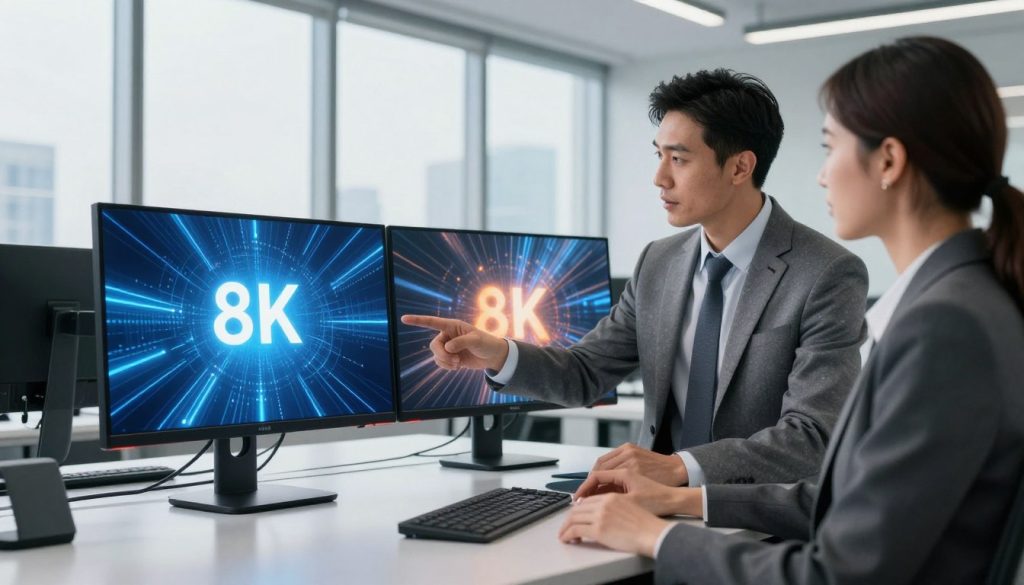
Choosing between native 4K and AI-enhanced 8K depends on how you use your display. Higher pixel counts are tempting, but the real benefit depends on your hardware and setting. Using 8k uhd ai porn content needs a smart approach to get the best visuals without using too much system power.
Assessing Your Viewing Distance
The human eye can only see so much detail at a certain distance. If you’re too far from your screen, the extra pixels in 8k uhd ai porn won’t make a difference. Find your best viewing distance to see the extra sharpness.
Sitting close to a big screen makes the experience more immersive. But if you’re at a standard distance, the difference between 4K and 8K is small. Comfort is more important than pixel density for watching long.
Prioritizing Frame Rate Over Resolution
Many people find that a higher frame rate makes a bigger difference than just more pixels. Smooth motion makes high-resolution media feel more real and engaging. Make sure your system can keep a steady frame rate when watching 8k uhd ai porn to avoid stuttering.
A smooth 60 frames per second at 4K is better than a choppy 30 frames per second at 8K. Motion clarity is key, but often overlooked when focusing on resolution. Always test your hardware before setting it to the highest settings.
Matching Resolution to Your Monitor Size
The size of your monitor determines how much resolution you really need. On small screens, 4K is already plenty, and 8K doesn’t add much. Match your resolution to your display size to avoid wasting processing power.
On big screens, 8K offers more benefits. Use the table below to decide the best setup for your display.
| Display Size | Recommended Resolution | Frame Rate Priority |
|---|---|---|
| Under 32 Inches | Native 4K | High (60+ FPS) |
| 32 to 55 Inches | Native 4K / AI 8K | Medium (60 FPS) |
| Above 55 Inches | AI-Enhanced 8K | Balanced (30-60 FPS) |
Advanced Techniques for Ultra HD Settings
To improve your viewing experience, you need to tweak your software settings. For those who want more, adjusting ultra hd settings can make high-resolution content look even better.
Utilizing Deep Learning Super Sampling
Deep Learning Super Sampling (DLSS) is a game-changer. It lets your system run smoothly while keeping the visuals sharp. This is thanks to AI-driven reconstruction that boosts frame rates without losing detail.
Customizing Sharpening Filters for Personal Preference
Sharpening filters let you fine-tune the sharpness of your images. Some like a soft look, while others want everything sharp. Finding the right balance is key to avoid noise or halos around bright spots.
Many specialists argue that HDR is visually more impactful than the jump from 1080p to 2160p.
Managing HDR Metadata for Better Contrast
Getting HDR metadata right is essential for deep colors and contrast. It ensures your display shows brightness correctly, avoiding over-bright or dark areas. Optimizing these ultra hd settings brings a realism that just resolution can’t match.
| Technique | Primary Benefit | System Impact |
|---|---|---|
| DLSS | Frame Rate Stability | Low GPU Load |
| Sharpening | Perceived Clarity | Negligible |
| HDR Tuning | Color Accuracy | Moderate |
Learning these advanced techniques helps your hardware perform its best. Regularly adjusting your ultra hd settings keeps your visuals sharp and future-proof.
Common Pitfalls When Scaling to 8K
Going to 8K is exciting, but you face technical challenges. Wrong ultra hd settings can ruin your viewing. Knowing these mistakes helps keep your content clear.
Avoiding Over-Sharpening and Halo Effects
One common mistake is over-sharpening. This can cause halo effects, which are bright, unnatural outlines. These effects make your ultra hd settings look harsh and digital.
To fix this, use sharpening filters carefully. Check for glowing edges on high-contrast subjects. Small changes can make a big difference in the look.
Recognizing When Upscaling Adds Unnecessary Artifacts
Not all content is good for upscaling. Blocky patterns or shimmering textures mean you’re pushing too hard. These issues often show up in fast scenes or complex areas.
If quality drops, try reducing upscaling or using native resolution. Prioritizing source quality is key for a clear picture. Don’t force low-bitrate files into 8K if it can’t handle it.
Ensuring Compatibility with Your Display Interface
Even with perfect software, your hardware must support 8K. Old cables can cause signal drops or color issues. Make sure you’re using HDMI 2.1 or DisplayPort 1.4 for high data throughput.
Check your monitor and GPU for compatibility. A weak connection can block your 8K experience. Reliable hardware connectivity is crucial for a great 8K view.
Future-Proofing Your Digital Media Library
Creating a digital library that lasts needs more than just space. You must think about how file formats and hardware will change. Planning ahead keeps your collection looking great and easy to access.
Archiving Strategies for High-Resolution Content
Good archiving means redundancy and high-quality storage. Keep at least two copies of your files on different drives to avoid losing data. Use strong file formats that keep high bitrates to protect your 8k ai porn collection.
Consistency is key for organizing folders and metadata. Use clear tags for easy searching as your library grows. External hard drives or NAS systems are great for long-term storage.
The Evolution of AI Video Enhancement Technology
Today’s 8K tech is like 4K was in 2014. It’s impressive but the content world is still catching up. AI upscaling is crucial during this time.
“The future of digital media lies not just in raw resolution, but in the intelligent processing of visual data to maximize clarity.”
As AI gets better, you can make older files look even sharper. This means your 8k ai porn will look amazing on future screens. Keeping your software up to date lets you use these new features without buying everything again.
Preparing Your Hardware for Next-Generation Standards
Modular hardware is key to keeping up with tech changes. A strong GPU makes handling high-bitrate files and AI easy. Choose components that support the latest display interfaces for future monitors.
Watch for new color depth and refresh rate standards. While you don’t need to upgrade every year, picking future-ready hardware avoids problems. A flexible setup keeps you ready for the next big thing in home theaters.
Conclusion
The move to 8K resolution is a big leap for display tech. Even though native 8K content is hard to find, we have tools to help. These tools let you make your standard formats look better.
You can make your viewing space your own. Mix native 4K’s clear look with AI upscaling’s smart processing. This way, your setup stays up-to-date with changing display standards.
Pay attention to your media’s quality and your graphics card’s power. A well-thought-out setup gives you a smooth, engaging experience. It also keeps your system running smoothly.
Try out different settings to find what works best for you. Your likes for sharpness and smooth motion will help you adjust. Enjoy making your digital space the best it can be.
FAQ
What is the primary difference between native 4K and 8K resolution in digital media?
The main difference is in pixel density. 4K has 3840 x 2160 pixels, while 8K has 7680 x 4320. This means 8K has four times more pixels than 4K. When watching 8k ai porn, these pixels make images look incredibly real.
However, seeing this detail well depends on your screen size and pixel density. On smaller screens, the extra clarity of 8K might be hard to notice.
Does my current hardware support ultra hd settings for 8K playback?
To play 8K smoothly, you need strong hardware. A powerful graphics card, like an NVIDIA GeForce RTX 4090, is essential. Also, your internet connection must be fast enough for high-bitrate streaming.
Make sure your display interface, like HDMI 2.1 or DisplayPort 1.4, supports high resolutions.
How does AI upscaling improve the quality of 8k ai porn files?
AI upscaling, found in tools like Topaz Video AI, adds missing details to low-res footage. It analyzes nearby pixels to reduce noise and grain and make images sharper. This makes old media look like it was shot in high definition.
Why would I choose native 4K over upscaled 8K content?
Choosing native 4K over upscaled 8K can be better. Upscaled 8K might look blurry or have motion issues. Native 4K usually looks clearer and more stable.
Knowing your viewing distance helps decide between 4K and 8K. Sometimes, 4K is better, even if it’s not as high a number.
How can I prevent my system from overheating during high-resolution playback?
High-resolution playback can make your system hot. To avoid this, keep your workspace cool and use good cooling solutions. This helps prevent frame drops and keeps your video playing smoothly.
What advanced ultra hd settings should I use for the best visual impact?
For the best look, tweak your ultra hd settings. Try Deep Learning Super Sampling (DLSS) for better performance. Adjust HDR metadata for better contrast and color.
Customize sharpening filters in players like MPC-HC or VLC Media Player to get the look you want.
What are the common pitfalls of scaling video to 8K?
Scaling to 8K can lead to over-sharpening and halo effects. It can also introduce unwanted artifacts. Finding the right balance between adding detail and keeping the original look is key.
How can I future-proof my digital media library?
To keep your collection up-to-date, use high-bitrate formats. Stay ready for new tech, like AV1 codec support. Update your display drivers regularly on Windows or macOS to keep up with new rendering methods.