Neural Engine 5.0 Explained: Sub-Surface Skin & Micro Expressions
Ever wondered why some digital characters seem lifeless, while others feel real? It’s often because of how light interacts with their skin and the tiny movements of their facial muscles. Thanks to new technology, this dream of realism is now a reality.
The neural engine 5.0 lets you turn static models into living, breathing characters. This tool makes it easy to create detailed textures and subtle expressions. With it, your animations can go from simple to convincing biological simulation.
In this guide, we’ll show you how to use these tools to bring your digital creations to life. You’ll learn how to enhance your assets and get professional results that grab your audience’s attention.
Key Takeaways
- Understand the core mechanics of sub-surface scattering for realistic skin.
- Learn to implement micro-expressions that add emotional depth to characters.
- Discover how to bridge the gap between static assets and reactive digital humans.
- Master the latest simulation tools available in neural engine 5.0.
- Improve your workflow to create more believable and engaging virtual actors.
Understanding the Core Architecture of Neural Engine 5.0
To fully use high-end graphics, you need to know the neural engine 5.0 framework. This version changes how systems handle complex data for better visuals. It moves from fixed rules to dynamic data handling for top-notch visuals.
Evolution from Previous Iterations
Old versions used pre-made assets and static lighting. They worked well but couldn’t capture movement’s subtleties. Now, the engine has a fluid, adaptive system that learns from data in real-time.
This change brings realism to a new level. You don’t have to animate every detail by hand. The system predicts and renders changes based on its logic.
Key Technical Specifications for Real-Time Rendering
The neural engine specs show big boosts in parallel processing. These changes help with the heavy work of real-time rendering. The engine also manages memory well, keeping textures clear even in busy scenes.
The table below shows the main tech benefits of this architecture:
| Feature | Capability | Benefit |
|---|---|---|
| Data Throughput | High-Bandwidth | Reduced Latency |
| AI Processing | Dedicated Cores | Faster Simulation |
| Rendering Path | Hybrid Neural | Enhanced Fidelity |
The Role of AI in Biological Simulation
AI is key in the engine’s biological simulations. It uses neural engine specs to accurately simulate skin behaviors like blood flow. This makes digital models feel very real.
For you, this means real-time rendering is easier. You can focus on your creative vision while the engine handles the complex physics. Learning these basics is crucial for getting top results.
Preparing Your Assets for Hyper Real AI Integration
To achieve a hyper real ai look, you need to understand how your 3D assets react to light and movement. Before starting the rendering, make sure your base geometry is ready for today’s engines. This means optimizing it for complex tasks.
Optimizing Mesh Topology for Facial Deformation
Your mesh topology is key for your character’s expressions. For smooth movements, focus on edge loops that mimic human face muscles. This helps avoid collapsing during extreme poses.
- Keep quad-based topology consistent on cheeks and jawline.
- Boost vertex density where deformation is high, like the mouth and eyes.
- Steer clear of long, thin triangles to prevent shading issues during animation.
High-Resolution Texture Map Requirements
High-quality textures are crucial for capturing human skin’s subtleties. With hyper real ai, you need maps that help the engine simulate light scattering well. This ensures the software can mimic pores and fine lines accurately.
“The quality of your final render is strictly limited by the fidelity of your input maps; garbage in, garbage out.”
Normal Map Calibration
Calibrating your normal maps is essential for skin biomechanics. These maps show how light interacts with the surface, mimicking real skin’s reactions. Aligning your normal data with the mesh ensures natural-looking stretching and folding.
Roughness and Specular Map Alignment
Roughness and specular maps show the skin’s oily or dry state. You must consider mechanoreceptor activation, which happens when the skin changes biomechanically. Correctly aligning these maps lets the engine adjust the surface sheen as the character moves.
| Map Type | Primary Function | Optimization Goal |
|---|---|---|
| Normal | Surface Detail | Preserve Micro-Depth |
| Roughness | Light Diffusion | Reflect Skin Moisture |
| Specular | Reflective Intensity | Maintain Material Logic |
Configuring Sub-Surface Scattering Parameters
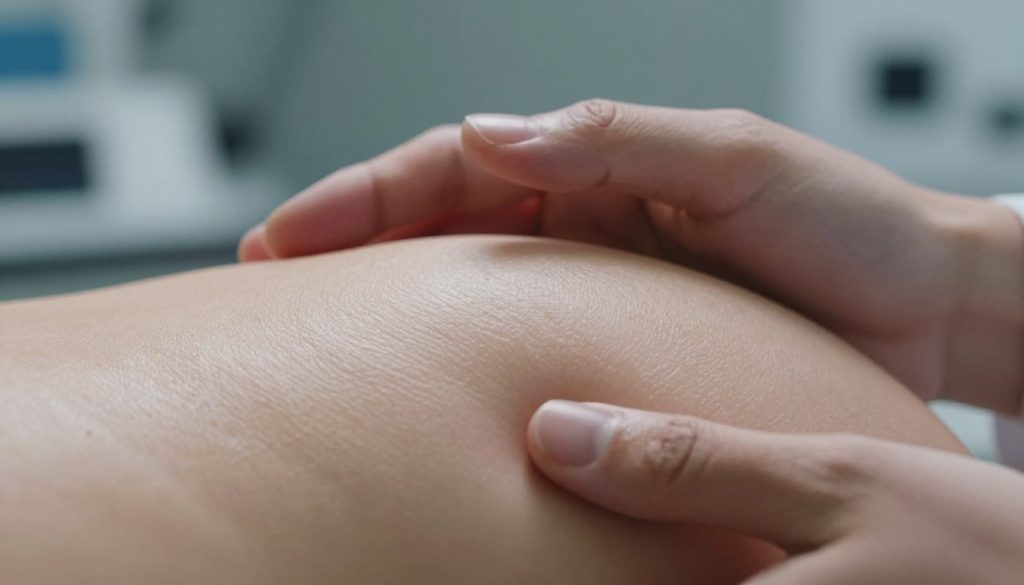
To make digital skin look real, you need to know how light acts on skin. Learning about sub-surface scattering helps you show how light moves through skin layers. This makes your digital skin look alive.
Defining Light Absorption and Scattering Coefficients
To get skin right, you must set absorption and scattering values. The top layer of human skin, the stratum corneum, is special. It’s very elastic and behaves like a spring.
Adjust your shaders to match these traits. Getting these values right makes light move through skin like it does in real life.
Setting Up Multi-Layered Skin Shaders
Today’s rendering engines use skin biomechanics to show how skin layers react to light. Create shaders that show the dermis, epidermis, and fat layers.
This method lets light spread in a more natural way. When you get these layers right, your digital characters feel more real. They look more inviting and lifelike.
Balancing Translucency with Depth Maps
Translucency is key for realistic skin. But, it must be controlled with depth maps. Too much makes skin look fake, too little makes it seem flat.
Depth maps help light travel the right distance before being absorbed. This fine-tuning keeps your character’s features sharp while adding a natural glow.
Adjusting Scatter Radius for Different Skin Tones
Every skin tone needs its own scatter radius settings. You must tweak these to keep light diffusion true to the character’s color.
These tweaks are crucial for mechanoreceptor activation. They affect how we feel the texture and softness of skin. By adjusting the scatter radius, your character looks real, no matter their skin tone or lighting.
Mapping Micro Expressions with Neural Engine 5.0
Mastering the link between muscle movement and skin changes can make your character’s emotions more real. To create authentic digital performances, you need to understand how internal structures affect the skin. Advanced facial expression recognition ensures every facial movement feels real.
Utilizing Facial Motion Capture Data
Starting with raw motion capture data is key to believable performances. You must map this data onto your character’s rig for accurate movement. This often means cleaning up the data to keep the original performance intact.
- Filter out jitter from high-frequency capture points.
- Align capture markers with the underlying skeletal structure.
- Normalize data ranges to match the engine’s coordinate system.
Implementing Muscle-Based Deformation Systems
The engine shines when using facial muscle deformation for surface geometry. Like acoustic sensing in research, your system should see muscle contractions as the main movement source. This creates a dynamic link between the character’s intent and their look.
Simulating skin movement over bone avoids the “rubber mask” look. This facial muscle deformation makes smiles and frowns look natural, with skin tension and compression.
Fine-Tuning Subtle Facial Movements
After setting the main animation, focus on the small details that make characters seem alive. These small changes are what people notice as life, even if they don’t realize it. Using acoustic sensing helps track these quick changes during speech and emotions.
Eye Dilation and Eyelid Micro-Twitches
The eyes are crucial for any viewer. Use automated systems for pupil dilation based on light and emotion. Adding random eyelid micro-twitches keeps the character from looking static during long talks.
Lip Sync and Perioral Muscle Activation
Perioral muscle activation is key for realistic speech. Make sure the mouth muscles move with the jaw and tongue for convincing speech. When these muscles work right, the facial expression recognition in the engine can better show the character’s feelings.
Optimizing Skin Texture Fidelity and Light Interaction
Improving your character models means mastering texture and light. You need a balance between technical skill and visual appeal. This focus greatly enhances the skin comfort perception of your digital humans.
Simulating Pore-Level Detail with Neural Upscaling
Getting pore-level detail is key for top-notch character work. But, high-res textures can make your project too big. Neural upscaling helps boost texture quality without increasing file size. It keeps your models sharp and natural, even up close.
This method creates detailed skin textures that look real. You don’t need huge 8K textures anymore. Instead, smart algorithms rebuild fine details on the fly.
Managing Global Illumination and Skin Reflection
Getting global illumination right is crucial for skin reflections. If reflections don’t match the scene, your character looks out of place. You need to fine-tune your shaders to match how light interacts with skin.
Using sub-surface scattering makes skin glow softly. When combined with accurate reflection maps, your character feels real. This blend is essential for creating believable digital humans.
Dynamic Lighting Adjustments for Realistic Skin Response
Your character needs to react to changing lights to keep the scene believable. Static lighting can’t capture the skin’s subtle changes as it moves. Dynamic lighting makes the skin adapt to light, shadows, and highlights in real-time.
These changes keep the skin looking natural, no matter the lighting. Whether it’s dark or bright, the shader adjusts to keep the natural look. This level of realism sets professional digital humans apart.
Troubleshooting Common Rendering Artifacts
When your real-time rendering project has visual errors, a careful approach is key. Even with top-notch engine settings, issues can still pop up. By tackling these problems early, you keep your digital characters looking their best.
Resolving Clipping Issues in Sub-Surface Layers
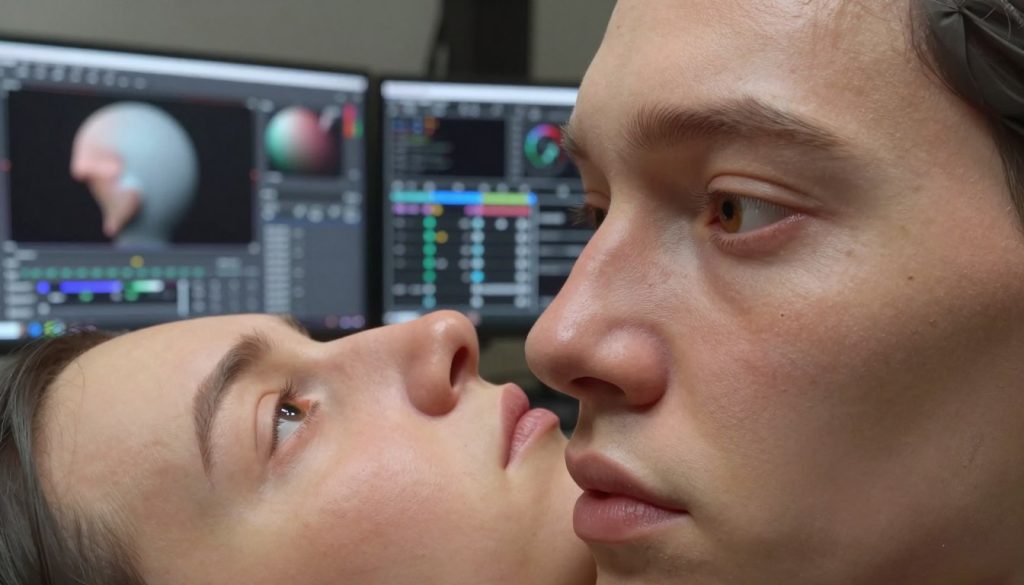
Clipping happens when the depth map doesn’t get the light absorption right. Make sure your translucency depth settings match your character’s mesh density. If the mesh is too thin, light will leak through, causing dark spots or holes.
To fix this, start by tweaking the scattering coefficients. Ensure your shaders are layered correctly to avoid depth misinterpretation. This stops light from escaping the character’s face too soon.
Fixing Jitter in Micro Expression Sequences
Jitter comes from shaky motion capture data or animation playback errors. FaceListener shows over 80% accuracy in facial expression recognition. If your character’s face shakes, check the animation curve smoothing filters.
Using acoustic sensing data can introduce noise if not filtered right. Make sure the data syncs with your frame rate to avoid stutters. Clean, noise-free data is crucial for smooth facial expressions.
Correcting Color Bleeding and Over-Saturation
Color bleeding occurs when global illumination is too strong for skin. Lower the bounce light intensity or adjust the albedo map to better absorb light. Over-saturation comes from wrong gamma correction or color space settings in shaders.
To look natural, balance specular highlights with diffuse color. If skin looks too shiny, reduce sub-surface scattering until it feels natural. Here’s a quick guide to common issues.
| Artifact Type | Primary Cause | Recommended Fix |
|---|---|---|
| Surface Clipping | Incorrect Depth Map | Adjust Translucency Scale |
| Expression Jitter | Unstable Motion Data | Apply Smoothing Filters |
| Color Bleeding | High Global Illumination | Reduce Bounce Intensity |
| Over-Saturation | Gamma Mismatch | Calibrate Color Space |
Advanced Techniques for Dynamic Facial Animation
Combining AI with artistic skill is key to digital performance. This mix lets you control your character’s actions perfectly. It makes your work both efficient and full of emotion.
Blending AI-Driven Expressions with Keyframe Animation
Layering AI data over keyframe work boosts your results. The AI handles small movements, while you control the big moments. Precision is key for capturing the scene’s emotional intent.
This method makes your facial animation feel real, not robotic. It connects raw data with the polished movements needed for top-notch films.
Creating Reactive Skin Responses to Environmental Changes
To truly showcase hyper real ai, characters must interact with their world. You can set up shaders to change based on light, temperature, or moisture. This makes your characters feel alive.
When a character steps into sunlight, its skin should change how it reflects light. This level of detail keeps the story immersive. It turns a digital character into a living being.
Automating Wrinkle Map Generation During Expressions
Keeping facial muscles accurate is tough. Automating wrinkle maps fixes this. It uses smart algorithms to match skin folds with expressions.
With neural upscaling, these maps stay clear even in close-ups. This mix of facial muscle deformation and neural upscaling adds unmatched detail. It saves time and boosts your work’s quality.
Performance Benchmarking and Hardware Requirements
To get the best out of Neural Engine 5.0, you need to know your hardware limits. When you work on facial animation, your system must handle big data smoothly. Managing resources well is key to turning a prototype into a final product.
GPU Memory Allocation for High-Fidelity Skin
High-quality skin textures need a lot of VRAM to look good. If your VRAM is too low, the engine might slow down. Using high-bandwidth memory helps keep texture fidelity sharp, even with complex movements.
Watching your VRAM in real-time helps spot problems early. Keeping your texture maps in check prevents system overload. This is crucial for keeping up with today’s neural engine specs.
“Performance is not just about raw power; it is about the intelligent allocation of resources to serve the visual narrative.”
Balancing Frame Rates with Visual Complexity
Keeping a steady frame rate with detailed skin is hard. You need to find the right balance between detail and smoothness. If your frame rate drops, your facial animation will look jerky.
Here are some hardware levels to consider for your project:
| Project Tier | Recommended VRAM | Target Resolution | Performance Goal |
|---|---|---|---|
| Entry Level | 8GB | 1080p | 30 FPS |
| Professional | 16GB | 1440p | 60 FPS |
| Cinematic | 24GB+ | 4K | 60+ FPS |
Hardware Optimization Tips for Neural Engine 5.0
To maximize your neural engine specs, benchmark your hardware often. This helps catch rendering artifacts early. Always keep your drivers up to date for the latest engine features.
Use proxy assets at the start to speed up your work. This reduces GPU load, letting you refine texture fidelity faster. Then, switch to high-res assets for the final touches to remove rendering artifacts.
Conclusion
To make digital humans look real, we need to understand how light works with living things. Neural Engine 5.0 helps us move from still images to characters that breathe and feel.
You now know how to improve your work flow and settings. Focus on how light and skin depth work together. This will make your stories more vivid.
Keep trying new things to get better. Change your settings to fit your project’s needs. See how these changes affect your final image.
Practicing with these advanced tools will make your characters more believable. Your hard work will make them connect with viewers on a deeper level.
Use these techniques in your next project to explore new ideas. The future of animation depends on your ability to mix science with creativity.
FAQ
What makes Neural Engine 5.0 unique for achieving a hyper real ai aesthetic in character rendering?
Neural Engine 5.0 is designed to mimic human skin’s complexity. It focuses on the skin’s biomechanics, unlike previous versions. This allows for hyper real ai visuals that react naturally to light and movement.
How should you optimize your mesh topology to support the neural engine specs for facial deformation?
Your mesh needs to handle facial deformations well. It should be dense to keep details sharp. Calibrate your maps to match these changes for realistic skin reactions to light.
What role does sub-surface scattering play in simulating diverse skin tones?
Sub-surface scattering (SSS) simulates light through the skin. In Neural Engine 5.0, you can adjust how light scatters. This creates a more realistic skin appearance across different characters.
How does the engine handle micro expressions like eyelid twitches and perioral activation?
The engine uses muscle-based deformation to capture micro expressions. It maps these movements with precision. This ensures your character’s emotions feel real, not robotic.
How can you troubleshoot rendering artifacts like jitter or clipping in sub-surface layers?
If you see jitter, check your sub-surface layers for clipping. Ensure your engine specs prevent color issues during intense light. Systems like FaceListener can guide you to over 80% accuracy.
Can you automate the creation of wrinkle maps during dynamic animations?
Yes, Neural Engine 5.0 automates wrinkle map generation. It blends AI and traditional animation for dynamic texture changes. This enhances your project’s visual fidelity.
What are the hardware requirements for balancing frame rates with high-fidelity skin rendering?
High-fidelity skin needs a lot of GPU memory. To keep frame rates stable, optimize your hardware for the engine’s needs. This ensures smooth, responsive visuals.