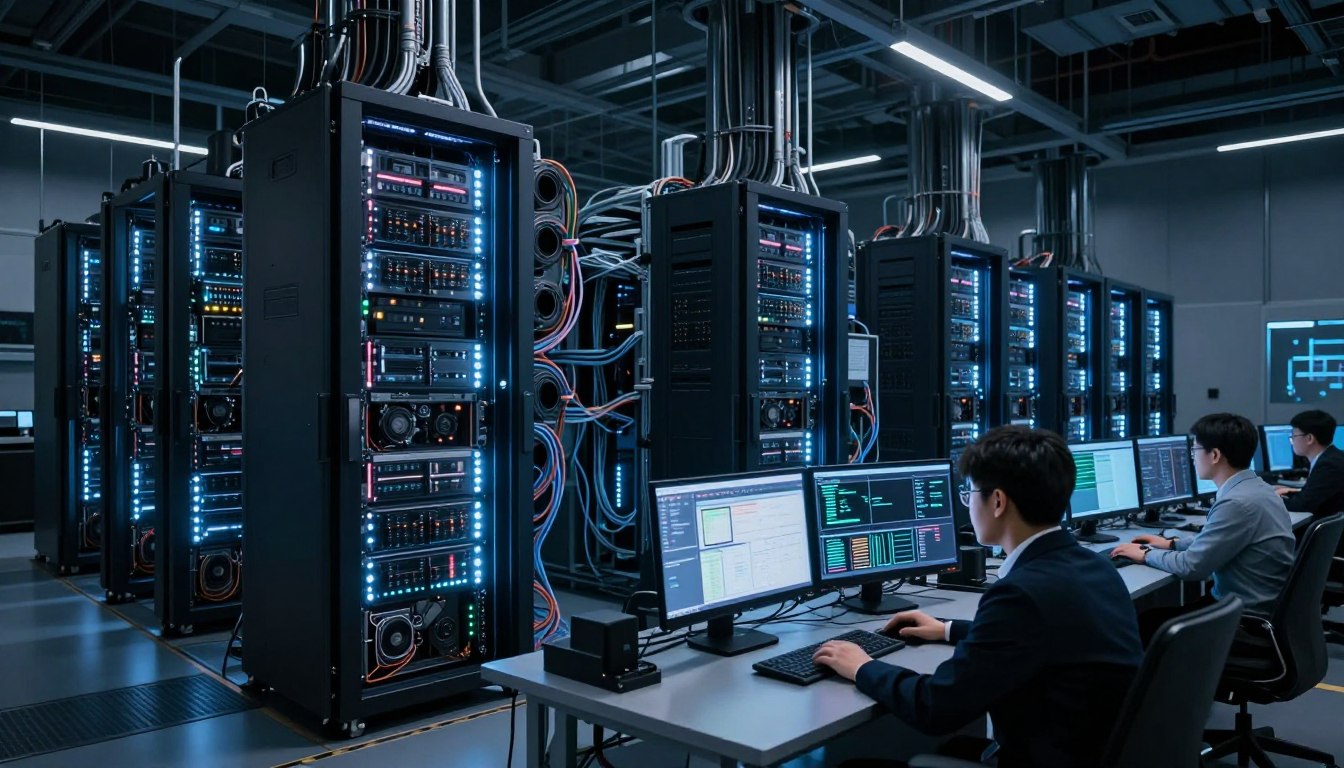
Neural Synthesis GPU Clusters: 0.8s/Frame Rendering Secrets
Ever thought your current setup might be limiting your creativity? In today’s fast world, hitting a 0.8s per frame goal is now the standard. It’s not just a dream anymore.
Modern machine learning shows that bigger models mean better predictions. To get these speeds, you need to learn how to use your hardware well.
With a specialized neural synthesis gpu cluster, you can handle huge amounts of data easily. This guide will show you how to make your setup faster and more efficient.
Key Takeaways
- Scaling deep models is vital for improving prediction performance in rendering.
- Achieving a 0.8s per frame target requires precise hardware orchestration.
- Heterogeneous systems are necessary to manage modern, high-parameter AI models.
- Optimizing your infrastructure leads to significant gains in rendering output.
- Strategic hardware choices allow you to maintain high-performance results consistently.
Hardware Foundations for Neural Synthesis GPU Clusters
Your journey to fast rendering starts with your computer’s setup. Building a strong neural synthesis gpu cluster means knowing how parts work together. Choosing top-notch parts keeps your system running smoothly during tough tasks.
Selecting Enterprise-Grade GPU Nodes
Choose nodes made for work, not just play. They need superior thermal management and lots of computing power. Server-grade hardware is key for working all day, every day.
“The true power of a rendering cluster is not found in a single card, but in the seamless orchestration of hardware that minimizes data travel time.”
Interconnect Technologies for Cluster Communication
Fast communication between nodes is crucial for a quick neural synthesis gpu cluster. Use fast interconnects like NVIDIA NVLink or InfiniBand. They let GPUs share info fast, helping hit your 0.8s frame goal.
Storage Solutions for High-Speed Asset Retrieval
Slow storage can slow down your whole system. Use NVMe storage to keep your neural synthesis gpu cluster fast. This ensures quick access to big files, keeping your work smooth.
| Component | Performance Metric | Primary Benefit |
|---|---|---|
| Enterprise GPU | Tensor Core Throughput | Rapid Model Inference |
| InfiniBand | Latency (Microseconds) | Node Synchronization |
| NVMe SSD | Read/Write IOPS | Instant Asset Loading |
| Liquid Cooling | Thermal Dissipation | Sustained Peak Speed |
Selecting the Right GPU Architecture for Rapid Inference
To get sub-second frame rendering, you need to know about modern GPU architectures. When setting up a neural synthesis gpu cluster, the hardware you pick is key. It’s the base for all calculations during the inference cycle.
Picking the right silicon is crucial for low latency. You must match your hardware with your rendering pipeline’s needs. This ensures your system performs well consistently.
Evaluating NVIDIA H100 and A100 Tensor Core Performance
The NVIDIA H100 and A100 are top choices for high-performance computing. The H100 uses the Hopper architecture, offering a big boost in floating-point throughput over the A100’s Ampere.
The H100’s Transformer Engine is a big deal for tasks needing lots of parallel processing. It adjusts precision to speed up training and inference. This makes it great for dense neural synthesis gpu clusters.
The Role of VRAM Bandwidth in Neural Synthesis
VRAM bandwidth is crucial for real-time rendering. It’s needed for quick data movement between memory and GPU cores. This avoids slowdowns.
To better use memory, think about RTX Neural Texture Compression. It uses AI to save up to 7x more VRAM than old methods. This lets your neural synthesis gpu cluster handle bigger, more detailed scenes without hitting limits.
Balancing FP8 and FP16 Precision for Speed
It’s key to balance precision and speed for your 0.8s frame goal. FP16 has been common, but FP8 offers big throughput gains.
Use FP8 for non-critical model layers to maximize rendering speed. This keeps visuals sharp while cutting down on work for your neural synthesis gpu cluster. Always check your models to avoid unwanted changes in your final image.
Optimizing Data Pipelines for Low-Latency Rendering
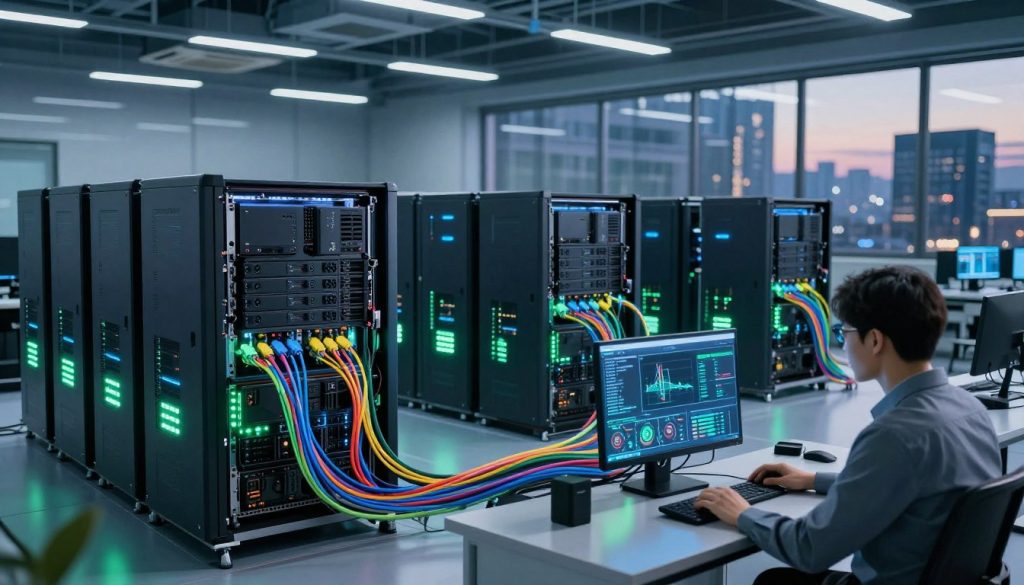
To meet your 0.8s rendering goals, you must remove all bottlenecks in your data pipeline. In a high-performance gpu cluster ai porn setup, data movement speed is key to frame quality. Making these paths faster means your hardware can compute more and wait less.
Reducing Input-to-Output Latency
Start by improving how you handle geometry and scene data. Tools like RTX Mega Geometry speed up BVH building, handling up to 100x more triangles than usual. This makes scene traversal faster, cutting down the time from input to output.
Focus on these areas to cut down delays:
- Pre-processing assets to fit your inference engine’s native format.
- Minimizing context switching between CPU and GPU during rendering.
- Prioritizing asynchronous compute tasks to keep the pipeline busy.
Implementing Direct Memory Access for GPU Buffers
Traditional data transfer methods often rely on the CPU, slowing things down. Using Direct Memory Access (DMA) lets the GPU get data directly from memory or storage. This skips the CPU, reducing jitter in your rendering pipeline.
This method is crucial for scaling your gpu cluster ai porn setup. It ensures fast access to high-resolution textures and neural weights. You’ll see smoother frames when the GPU handles its own buffer requests.
Caching Strategies for Real-Time Neural Weights
Neural synthesis models need constant access to large weight files. If these weights are fetched from slow storage every frame, performance drops. You need a tiered caching strategy to keep important weights in fast VRAM or NVMe buffers.
Good caching means:
- Predictive loading of weights based on scene trajectory.
- Weight quantization to shrink model memory size.
- Dedicated cache partitions to keep neural data safe from system tasks.
Implementing Neural Synthesis Models for 0.8s Per Frame
To reach your goal of 0.8s per frame, you need to improve your neural network design. High-quality rendering requires cutting down on each layer’s processing time. Whether you’re setting up a gpu cluster ai porn system or a basic visual synthesis pipeline, speed comes from efficiency.
Model Pruning and Quantization Techniques
Pruning removes unnecessary weights from your neural network. This makes your model smaller and uses less memory. Quantization then speeds things up by changing high-precision weights to lower ones like INT8 or FP8.
These methods help run complex models on less powerful hardware without losing quality. For example, the Mistral Nemo Minitron 2B model is a great example. It only needs 1.5 GB of VRAM, making it perfect for quick tasks.
Distilling Large Models for Edge-Cluster Deployment
Model distillation is key for moving big tasks to the edge. It trains a smaller “student” model to act like a big “teacher” model. This way, your gpu cluster ai porn apps on the edge are fast and accurate.
- Reduced Latency: Smaller models need less time to process each frame.
- Lower VRAM Usage: Efficient models fit in your GPUs’ fast cache.
- Scalability: You can use more instances in your cluster with smaller models.
Optimizing Activation Functions for Faster Throughput
The type of activation function you use affects how fast your hardware works. Instead of using common functions like ReLU, you can pick faster ones. This choice boosts your frame generation speed.
By focusing on these optimizations, your pipeline stays fast even when it’s busy. When your activation functions are set for maximum throughput, you avoid slowdowns. This careful approach helps keep your rendering at 0.8s per frame.
Configuring Distributed Computing for Parallel Processing
Building a high-performance rendering environment relies on distributed computing. By using multiple nodes, you can tackle complex tasks that one machine can’t handle. This way, your system keeps up with the needed speed to meet your goals.
Load Balancing Across Multi-GPU Nodes
Load balancing is key to avoid bottlenecks. Use the HAP system for heterogeneous clusters to boost performance. It can speed up your tasks by up to 2.41x by optimizing how data is shared and processed.
Even distribution keeps your gpu cluster ai porn rendering smooth. Without it, your system might drop frames and slow down. Always check your nodes to keep the workload balanced, especially when it’s busy.
Synchronizing Frames in a Distributed Environment
Syncing frames in a distributed setup needs precise timing and good management. Every node must work together perfectly to avoid any visual issues. This ensures a smooth output stream.
“Efficiency in distributed systems is not just about raw power; it is about the perfect orchestration of every individual component working toward a singular goal.”
Managing Network Jitter in Cluster Rendering
Network jitter can harm your rendering if not managed. Use low-latency protocols to keep data moving smoothly between nodes. Even small delays can mess up the timing needed for fast synthesis.
These strategies help you use your hardware’s full potential. They work for both big gpu cluster ai porn setups and smaller farms. A well-configured system means consistent performance.
Managing Thermal and Power Constraints in High-Density Clusters
To hit a 0.8s per frame goal, you need more than just fast processing. You also need a strong physical setup. High-performance cards in one rack can get too hot. It’s crucial to manage this heat to keep your gear running smoothly.

Liquid Cooling Solutions for Sustained Peak Performance
Old air cooling methods can’t handle today’s GPU heat. Liquid cooling is better at moving heat away from the chips. It stops heat buildup that slows down performance during long tasks.
Power Distribution Unit Requirements for GPU Clusters
Your PDUs are key to keeping your cluster stable. Modern cards use a lot of power, especially when working hard. Make sure your PDUs can handle these high currents to avoid problems.
Monitoring Thermal Throttling to Maintain 0.8s Targets
Thermal throttling can quietly slow down your system. If it gets too hot, your gear will slow down to stay cool. This means you won’t reach your 0.8s per frame goal.
It’s vital to watch your system closely. By tracking data in real-time, you can spot and fix heat issues before they slow you down. Staying cool is the only way to meet your 0.8s per frame goal when working hard.
Software Stacks and Frameworks for Real-Time Synthesis
Your software stack is key to achieving 0.8s per frame rendering speeds. Choosing the right tools makes sure your hardware is used to its fullest. This setup helps you fine-tune your workflow for better stability and speed.
Leveraging TensorRT for Model Optimization
Using NVIDIA TensorRT is crucial for cutting down inference latency in your models. It optimizes neural networks by merging layers and adjusting precision. Efficient model optimization is what lets your system consistently hit the 0.8s per frame goal.
“The true power of modern GPU clusters is unlocked only when the software stack is perfectly aligned with the underlying silicon architecture.”
Custom CUDA Kernels for Specialized Rendering Tasks
Standard libraries might not meet the needs of high-speed neural synthesis. In such cases, creating custom CUDA kernels is the way to go. Writing this low-level code gives you detailed control over GPU memory and execution.
This method helps you avoid generic slowdowns in complex visual tasks. Tailoring your kernels can significantly boost performance in specific rendering tasks.
Orchestrating Containers with Kubernetes for GPU Workloads
Handling complex GPU workloads across a large cluster needs strong orchestration. Kubernetes is the tool to scale your rendering tasks while keeping 0.8s per frame performance. It makes deploying, monitoring, and updating containers easy without interrupting the pipeline.
| Software Tool | Primary Function | Performance Impact |
|---|---|---|
| TensorRT | Model Optimization | High |
| CUDA | Kernel Development | Very High |
| Kubernetes | Cluster Orchestration | Medium |
| Docker | Containerization | Low |
Combining these frameworks creates a unified environment for your rendering needs. You have full control over your setup, ensuring every frame meets your tight timing requirements.
Troubleshooting Common Bottlenecks in Rendering Pipelines
To keep your rendering speed at 0.8s per frame, you need to check your system often. When your pipeline slows down, it’s usually because of hardware issues. Finding and fixing these problems helps your cluster work better.
Identifying PCIe Bus Saturation
PCIe bus saturation happens when too much data moves between GPUs and memory. This slows down your system, making it hard to reach 0.8s per frame. Watch your bus usage to avoid this problem.
If data transfer times are slow, try adjusting buffer sizes or using faster PCIe lanes. Fast data movement is crucial for quick rendering.
Debugging Memory Leaks in Neural Synthesis Loops
Memory leaks can make your system slower over time. As RAM use grows, swapping can slow things down even more. Look for objects that don’t get cleared after use.
Profile your code often to find these leaks. Tools for managing memory can help keep your rendering smooth and fast.
Analyzing Frame Time Variance and Stutter
Frame time variance, or stutter, shows when nodes in your cluster aren’t in sync. This makes the whole pipeline shaky. Look at logs to find out which nodes are slow.
The table below shows common problems and how they affect your pipeline:
| Bottleneck Type | Primary Symptom | Performance Impact | Recommended Action |
|---|---|---|---|
| PCIe Saturation | High data latency | Reduced throughput | Optimize buffer sizes |
| Memory Leak | Gradual frame drift | System instability | Profile memory usage |
| Network Jitter | Visible stuttering | Inconsistent frame rate | Sync node clocks |
| Thermal Throttling | Sudden clock drops | 0.8s target failure | Improve cooling flow |
Fixing these issues keeps your pipeline running smoothly. Consistency is key for top-notch neural synthesis results.
Conclusion
Building a strong neural synthesis infrastructure needs the right mix of hardware and software. You now have the steps to hit a 0.8s per frame rendering speed in your GPU clusters.
Success in this area depends on combining NVIDIA H100 nodes with efficient data pipelines. It’s crucial to keep communication fast to maintain a smooth rendering process. Always watch your system’s temperature and power use to keep performance high.
Your path to real-time synthesis includes testing and improving your CUDA kernels. See your cluster as a dynamic system that needs updates to lead the industry. Keeping an eye on frame time variance helps meet the 0.8s per frame goal, even when workloads are high.
Work with your tech team to check these metrics and find ways to improve. Your dedication to these advanced rendering methods will keep your projects at the top of visual technology. Begin making these changes now to boost your production abilities.
## FAQ
### Q: What hardware infrastructure is required to reach a consistent 0.8s per frame rendering speed?
To hit this speed, you need a top-notch GPU cluster. It should have NVIDIA H100 or A100 Tensor Core nodes. Use NVLink interconnects and Direct Memory Access (DMA) to speed up data transfer.
### Q: Why is the gpu cluster ai porn industry shifting toward neural synthesis for content generation?
The demand for detailed, generative content is high. Neural synthesis makes it possible to create complex, realistic frames fast. This is key for scalability and real-time interaction.
### Q: How does VRAM bandwidth impact the visual quality of your rendered outputs?
VRAM bandwidth affects how quickly textures and neural weights load into the GPU. For a heterogeneous cluster, more bandwidth is crucial. It helps NVIDIA H100 units handle big data without slowing down.
### Q: Can you achieve a 0.8s per frame target using standard FP32 precision?
No, it’s unlikely with FP32 alone. Mix FP8 and FP16 for better performance. Lower-precision formats boost efficiency on Tensor Cores without losing quality.
### Q: What is the benefit of model distillation for your rendering pipeline?
Model distillation compresses a large model into a smaller one. This smaller model runs faster on your cluster. It’s essential for quick inference in edge deployments.
### Q: How do you prevent PCIe bus saturation from slowing down your cluster?
Prevent PCIe saturation by optimizing data transfer. Use NVIDIA GPUDirect Storage and PCIe Gen5 interfaces. This keeps data flowing for fast synthesis.
### Q: Why is liquid cooling recommended for high-density NVIDIA A100 clusters?
High-density clusters get very hot during intense tasks. Liquid cooling is better than air cooling. It prevents overheating and keeps GPUs running at top speed.
### Q: How does TensorRT optimize neural networks for real-time synthesis?
NVIDIA TensorRT optimizes neural networks for your hardware. It tweaks activation functions and layer fusion. This ensures your models run efficiently on NVIDIA H100 nodes.
### Q: What role does load balancing play in distributed rendering environments?
Load balancing spreads tasks evenly across nodes. This prevents any node from slowing down the whole cluster. It’s key for synchronized output and fast rendering.
### Q: How can you manage network jitter in a multi-node GPU cluster?
Manage network jitter with good network tools and high-speed switches. Use NVIDIA Quantum InfiniBand for precise timing. This keeps your pipeline smooth and stutter-free.