
Semantic Prompt Parsing: Advanced Examples in Plain English
Ever wondered why data tools fail when document formats change? For years, businesses used old, rigid systems. These systems couldn’t handle even small layout changes. This led to wasted time and costly errors in daily work.
A new era of intelligent automation is here. Now, you can use large language models to extract data from messy texts with simple instructions. This method, called semantic prompt parsing, lets your software understand context, not just patterns.
This change from old rules to new instructions is changing how we handle information. With semantic prompt parsing, you can process different documents more accurately and with less manual work. It’s time to leave behind old scripts and embrace a more flexible data management approach.
Key Takeaways
- Traditional rule-based extraction is often too rigid for modern business needs.
- Large language models enable a more flexible approach to data processing.
- Natural language instructions replace complex, hand-coded extraction rules.
- This technology significantly improves both efficiency and accuracy in data workflows.
- Adopting these advanced methods helps your team scale operations without increasing manual labor.
The Fundamentals of Semantic Prompt Parsing
Semantic parsing changes how we tell AI what to do. It moves away from strict, old rules that break with new data. Now, you can use natural language to guide your systems. This makes them more flexible and smart.
Defining Semantic Structure in AI Communication
Semantic structure in AI means understanding the real meaning and connections in data. It’s not just about finding text in a certain spot. It’s about grasping the context and intent behind the information.
Modern models use pre-trained language knowledge to spot important data. This makes semantic prompt parsing a game-changer for automation. You don’t have to worry about small formatting changes messing up your data flow.
Why Parsing Matters for Complex Requests
As you handle more documents and different formats, old templates can’t keep up. You need a way to handle complex requests without always updating your code. Advanced parsing techniques offer a big leap over old systems.
Switching from rigid rules to semantic understanding leads to better results. This is key for keeping accuracy in intricate data extraction tasks. By focusing on meaning, your AI stays strong as your business grows.
Deconstructing Your Intent into Logical Components
Turning vague ideas into clear instructions is key to good AI communication. Breaking down your goals into smaller parts helps the model understand better. This method is like a semantic prompt guide, keeping your intent clear.
Identifying the Core Task
The first step is to find the main goal of your request. Clearly stating what you want the model to do helps it focus. This uses natural language processing to make sure the AI knows what to do.
Sticking to one task keeps the model on track. State your goal simply to avoid confusion. When the task is clear, the model can work efficiently to meet your needs.
Establishing Constraints and Parameters
After setting the core task, you need to define strict limits for the output. These limits help the model focus on what’s important. By doing this, you make the system work better and improve your results.
Here’s a table to show how structured components help:
| Component | Unstructured Approach | Structured Approach |
|---|---|---|
| Core Task | Vague or multi-part | Single, clear objective |
| Constraints | None or implied | Explicitly defined limits |
| Data Focus | Everything included | Relevant data only |
| Output Quality | Inconsistent | High and predictable |
Using this semantic prompt guide helps you control the AI communication process. By applying natural language processing to your work, you make every interaction better. Remember, clear input leads to better results.
Step One: Defining the Persona and Role
Your journey to better AI results starts with a clear persona. By giving a specific role to the model, you provide the domain context it needs. This step is key to making advanced AI easy for non-tech users to use.
Selecting the Right Expert Profile
Choosing an expert profile tells the AI which knowledge to use. Whether you need a tech expert, a writer, or a financial analyst, the persona matters. This is a crucial part of prompt engineering.
Here are the benefits of choosing a specific expert role:
- Increased precision in technical terms.
- Better relevance of suggested solutions.
- Less chance of generic or off-topic answers.
Setting the Tone and Style Guidelines
After picking a persona, you need to set the tone and style. Your semantic prompt guide should say if the output should be formal, casual, or technical. This control helps align AI content with your needs.
Good prompt engineering needs these clear rules for quality. By setting these early, every interaction stays professional and on-brand. You’re not just asking a question; you’re guiding an expert to give you what you need.
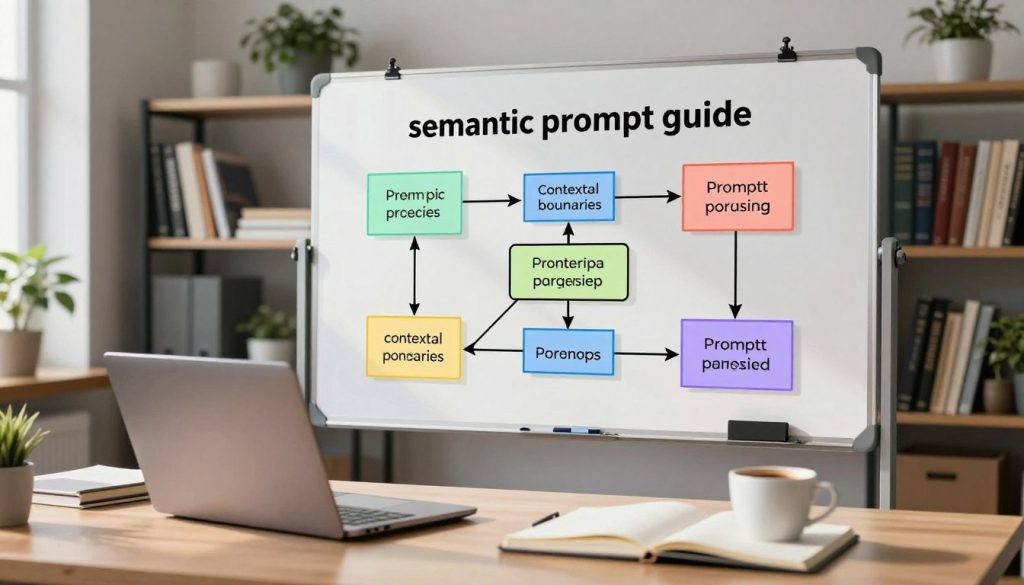
Step Two: Establishing Contextual Boundaries
Knowing exactly where the AI should stop is key. Clear boundaries prevent it from going off track. This is crucial for any semantic prompt guide, keeping your output precise and relevant.
Providing Background Information
Give the AI enough context to understand your documents better. Provide enough detail so it knows the task’s purpose. This helps it focus on what’s important and ignore the rest.
When dealing with new document formats, adjust your prompts for better performance. A clear roadmap helps the model extract structured data more reliably. Context is the bridge between a vague request and a precise result.
“The quality of your output is directly proportional to the clarity of your input constraints.”
Defining What to Exclude
It’s also key to tell the model what to ignore. List what to exclude to avoid hallucinations or irrelevant data. This is crucial for keeping your structured data extraction efforts clean.
By setting these boundaries, the AI stays focused on what’s important. This is vital for avoiding unnecessary data. Following this semantic prompt guide makes your AI interactions professional and effective.
Step Three: Structuring the Input Data
Mastering the art of input organization is key in prompt engineering. The way you arrange data affects the AI’s output quality. A clear pipeline ensures your results are accurate and predictable.
Using Delimiters for Clarity
Delimiters are like signs that tell the model where to start and stop. Symbols like triple quotes or dashes help the AI know what to process. This is crucial in natural language processing to avoid confusion.
Clear boundaries reduce the chance of the model getting your message wrong. Consistency is key when picking delimiters. A standard set makes parsing complex documents easier.
Organizing Lists and Tables
Turning messy text into organized lists or tables helps the model understand better. This structured approach lets it handle complex layouts with precision. Logical formats make it easier for the model to find specific values.
Here’s a structure to improve your input data:
| Data Type | Format | Benefit |
|---|---|---|
| Raw Text | Delimited | High Accuracy |
| Key Values | Table | Easy Parsing |
| Instructions | Bulleted List | Clear Logic |
Using these formats in your prompt engineering strategy improves AI interactions. A well-organized input is essential for success.
Step Four: Defining the Desired Output Format
You can turn messy AI responses into clean, useful data by learning about output formatting. When you clearly say how you want the information, you make it easier to use. This is key for actionable data and prompt patterns that are ready to go.
Standardizing your requests makes structured data extraction easier. This reduces the need for manual cleanup and keeps your digital work flowing well.
Specifying File Types and Structures
Large language models can give you data in many formats. You might need a Markdown document for a report or a JSON object for a web app. You must tell the model what you want.
You can ask the model to show data in a table for easy comparison. Consistency is key for automated pipelines that need predictable formats.
Requesting Specific Data Schemas
You can also ask for strict data schemas to fit your databases perfectly. By giving a template or a list of fields, you help the model create machine-readable content every time. This detail is crucial for structured data extraction.
When you define the schema, you remove any confusion in the output. This precision lets your apps read the data without errors. By spending time on these details, you save a lot of effort later.
Advanced Techniques for Complex Requests
To boost your LLM performance, you need to go beyond simple commands. When dealing with complex requests, basic prompts often don’t cut it. By using structured methods, you can help the model give you better and more reliable answers.
Chain of Thought Prompting Explained
Chain-of-thought prompting is a key method. It tells the model to think step by step before answering. This way, it breaks down complex requests into simpler parts.
By making the model show its work, you get more accurate answers. This is especially true for tasks that need math or logical thinking. It helps ensure the answers are based on solid logic, not just patterns.
Iterative Refinement Strategies
Iterative refinement lets you tweak your prompts based on the model’s first try. It’s like having a conversation with the AI. You can point out what’s missing and guide it toward the right answer.
Adding few-shot learning examples helps the model understand complex data better. By giving it a few examples, you show it how to handle tricky data. This makes your automated tasks more reliable and consistent.
| Technique | Primary Benefit | Best Use Case |
|---|---|---|
| Chain of Thought | Logical Accuracy | Complex Reasoning |
| Few-Shot Learning | Pattern Consistency | Data Extraction |
| Iterative Refinement | Output Precision | Ambiguous Tasks |
Handling Ambiguity Through Semantic Clarification
Ambiguity can block clear communication with large language models. When your instructions are unclear, the model might give wrong or useless answers. By focusing on semantic clarification, you make sure your message is clear and followed.

Identifying Vague Language
Start by spotting words that cause confusion. Words like “summarize,” “analyze,” or “fix” are too broad for machines without clear details. This vagueness makes the model guess what you want, often leading to poor LLM performance.
Look for vague adjectives or unclear scopes in your prompts. If your request doesn’t mention format, length, or audience, it might not get the right data retrieval results. Finding these gaps early lets you refine your language before the model acts on it.
Reframing Prompts for Precision
After spotting vague words, rewrite your prompts to be clear and specific. Using known prompt patterns helps you follow best practices, making outputs more consistent. This method uses natural language processing to match the model’s actions with your goals.
Don’t ask for a vague summary; specify what you need exactly. Give clear examples or rules to avoid mistakes. This careful approach to crafting prompts is key for top LLM performance and using natural language processing effectively in your work.
Practical Examples of Semantic Parsing in Action
Semantic prompt parsing shows how to connect what we mean with what machines do. It goes beyond just matching keywords. This way, AI models can really understand what we ask for.
This change means the answers we get are not just right. They are also very accurate and know the context.
Transforming a Basic Request into a Semantic Masterpiece
Let’s say you want a summary of a marketing campaign. A simple ask might be “summarize the campaign data.” But this often leads to answers that are too general.
To make a semantic masterpiece, you need to tell the AI what to focus on. You should say who the audience is and what metrics are important. This way, the AI can extract data in a structured way. It’s like teaching it to find patterns, not just words.
Parsing Technical Documentation Queries
In technical documentation, getting things right is key. You need a system that can handle complex terms and understand the structure of the query. Effective data retrieval means setting clear limits for the AI.
Using descriptive frameworks helps the AI find the right data. This is crucial when you’re looking at API specs or troubleshooting guides. The table below shows how changing your approach can improve the quality of the data you get.
| Feature | Basic Keyword Approach | Semantic Parsing Strategy |
|---|---|---|
| Data Focus | Surface-level keywords | Contextual relationships |
| Output Quality | Often fragmented | Highly structured and logical |
| Retrieval Speed | Fast but inaccurate | Optimized for precision |
| User Effort | Low initial, high cleanup | High initial, low cleanup |
Common Pitfalls and How to Avoid Them
Working with prompt engineering needs a mix of detail and simplicity. When you deal with complex requests, how you input information affects the quality of the output. Small mistakes can greatly lower LLM performance. It’s crucial to spot and fix these issues early.
Over-Prompting vs Under-Prompting
It’s key to find the right balance in your instructions. Over-prompting happens when you give too much info that confuses the model. This can make the AI lose focus and not meet your main goals.
On the other hand, under-prompting means not giving enough info. This can lead to generic answers that don’t meet your needs. Aim for clear, yet detailed instructions that guide the AI without overwhelming it.
Managing Model Hallucinations
In critical areas like medical records, accuracy is a must. LLM hallucination risk is a big concern that can cause fake data. To avoid this, use strict validation steps and clear rules.
Using few-shot learning is a great way to boost reliability. By giving a few good examples, you help the model understand what you want. This method cuts down on errors and keeps your data safe and reliable.
| Strategy | Primary Benefit | Risk Mitigation |
|---|---|---|
| Few-shot learning | Higher consistency | Reduces hallucinations |
| Constraint setting | Better focus | Prevents over-prompting |
| Validation layers | Data integrity | Filters incorrect output |
Testing and Validating Your Parsed Prompts
To get consistent results from AI, you need a solid plan for checking and measuring performance. This last step of prompt engineering makes sure your systems stay reliable as your data changes or grows.
Benchmarking AI Responses
Check if your logic works by comparing AI outputs with a known dataset. By testing your inputs in a controlled way, you can see how well your prompt patterns work. You’ll also find out where the model might have trouble.
Consistency is the hallmark of a high-quality system. Benchmarking your results gives you a clear view of how well your instructions are followed. This helps you spot mistakes before they affect your work.
Adjusting Variables for Better Accuracy
After finding performance gaps, start tweaking your settings. Good prompt engineering means adjusting things like temperature, which affects output randomness, or improving your examples.
Maybe adding more specific rules or changing the order of your prompt patterns will make your AI more accurate. Continuous validation is key. It lets you adjust your approach as document types change, keeping your AI a reliable tool for your business.
Conclusion
Semantic prompt parsing changes how we get structured info from unstructured sources. It uses smart, flexible instructions that fit your needs. Now, you can turn raw text into useful insights more accurately.
Your success comes from testing and improving your prompts. Using few-shot learning helps your models learn patterns better. This keeps your data retrieval work precise as your needs get more complex.
AI is getting better fast. These parsing methods are key for smart and scalable document understanding. You can now make systems that handle many types of inputs well.
Start using these strategies in your projects now. Share your experiences to help others improve their AI work. Your path to better prompt engineering starts with these steps.
FAQ
What exactly is a semantic prompt guide and how does it improve my AI interactions?
A semantic prompt guide helps you go beyond simple keywords. It focuses on the meaning and relationships in your data. This way, your complex requests are understood well by models like GPT-4 or Claude 3.5 Sonnet. This leads to more reliable and consistent results.
Why is deconstructing intent necessary for handling complex requests?
Breaking down your intent into parts makes it easier for the model to understand. This method helps you clearly state what you need. It’s important for getting the right data from large documents like those in SharePoint or Google Drive.
How does defining a specific persona impact LLM performance?
Choosing a persona, like a senior data analyst, gives the model the right context. This context affects the tone and style of the response. It makes sure the AI meets your professional standards.
What are contextual boundaries and why are they important for data retrieval?
Contextual boundaries are like rules for the model. They tell it what to include or ignore. This is crucial for avoiding irrelevant data, especially with varied formats like Adobe PDF invoices or medical records.
How do delimiters and structured input improve the parsing of messy data?
Delimiters like triple backticks or XML tags guide the AI. They help organize your input into lists and tables. This makes it easier for the model to handle complex layouts, even with unstructured data.
What output formats can I request for my structured data extraction?
You can ask for data in formats like JSON, Markdown, or CSV for Microsoft Excel. Standardizing your output makes it easy to use in your Salesforce CRM or other databases without extra work.
How do chain-of-thought prompting and few-shot learning enhance accuracy?
Chain-of-thought prompting makes the model explain its steps before answering. Few-shot learning uses examples to teach the model to handle complex scenarios better. This improves accuracy beyond simple instructions.
How can I use semantic extractors to resolve ambiguity in my prompts?
Semantic extractors help find data that’s not directly stated. They use natural language processing to clarify your intent. This reduces errors in the AI’s response.
What are the risks of over-prompting or under-prompting the AI?
Over-prompting can confuse the AI and make it ignore important details. Under-prompting might lead to incomplete or generic data. Finding the right balance is crucial for avoiding mistakes.
How should I test and validate my parsed prompts for better accuracy?
Test AI responses against known data to check their accuracy. Adjust settings or refine examples to improve results. Continuous testing keeps your data extraction pipeline strong as you grow your operations.